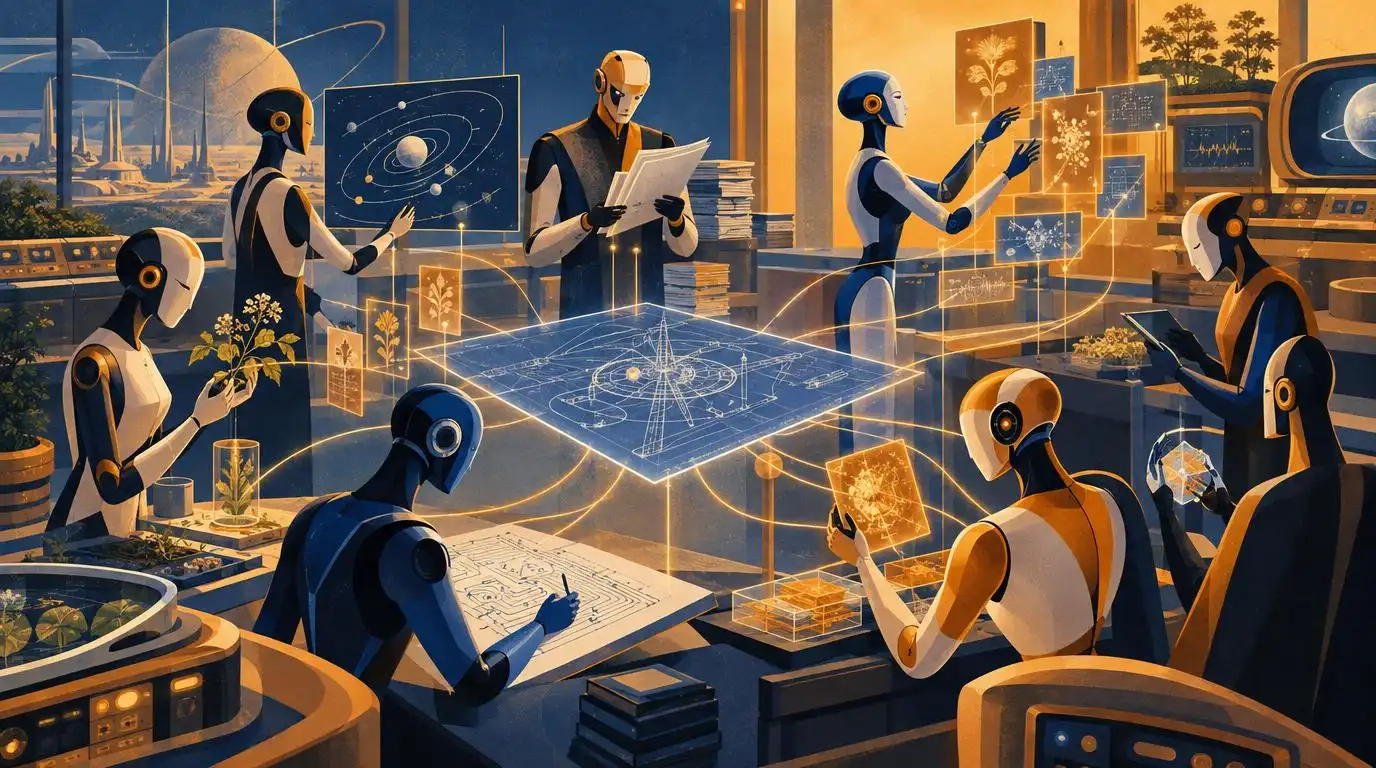
"Designing an innovation lab: eight minds, one board"
meta design multi-agentEvery multi-agent setup you read about clones a software team: a researcher, a developer, a tester, a reviewer. Fine for building known things. Nearly useless for discovering unknown ones — because eight copies of the same model with the same prompt shape produce eight copies of the same thoughts.
This post is about the design decisions behind the lab, made before any agent ran a single task.
Agents as identities, not roles
A "researcher" role produces research-shaped filler. An identity produces discoveries. Each of the lab's eight profiles got a SOUL.md with four parts: a sharply-scoped purpose, a numbered working protocol, an output contract (the exact line format the agent must emit), and — most important — the refusals.
The science scout's contract, for example:
MECHANISM: <what it does, domain-free> | SOURCE: <link> |
TRANSFER HINT: <where a similar problem exists> | SIMULATABLE: <yes/no>
That format is quietly load-bearing: it means the combinator can consume scout output mechanically, and a human can audit the pipeline at a glance. And the refusal clauses — "you do not propose products", "you do not evaluate your own concepts" — are how role separation is enforced when there's no type system for thoughts.
The moves
The combinator doesn't brainstorm. It works through named moves: adjacent, cross-domain, temporal (old idea × new capability), constraint, inversion, removal, composition, analogy. Each move is a different search direction through combination space — and requiring "at least one genuinely strange concept" per batch keeps the output from collapsing to the obvious.
Kill conditions and rubrics
Every concept carries its own kill condition before it's built, and the critic scores on six axes (novelty, usefulness, feasibility, surprise, testability, cost-to-test) with one rule that does more for quality than any prompt engineering: nobody scores their own work.
What we spent
Nothing yet. The design phase is markdown files and decisions — board, profiles, SOULs, one shared skill with the record schema. The next post is where the money starts.